Being cited now matters more than ranking first
· 8 min read
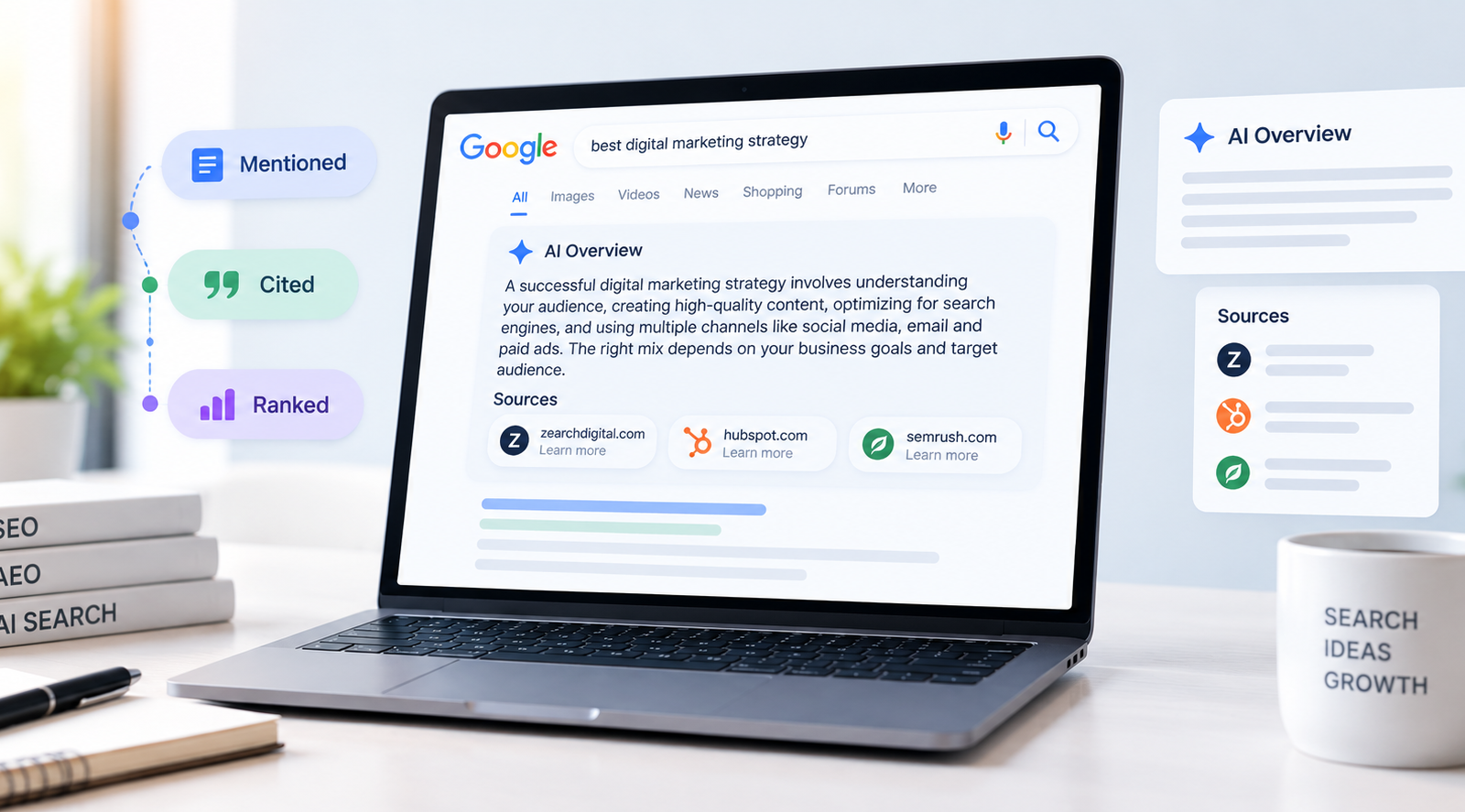
Ranking still matters. AI search has not replaced it. What has changed is the visibility surface around the ranking: a searcher may see an AI-generated answer, the sources behind it and traditional organic results before deciding where to click.
That makes citation visibility an additional SEO question. Where do we rank? Are we mentioned? Are we cited? Which URL is cited? And is the information about the brand accurate?
What the Research Actually Shows
There is no single universal number for how AI Overviews change organic CTR. Studies use different datasets, query types, time periods and methods. Two recent studies are useful precisely because they show measurable effects while requiring careful interpretation.
Ahrefs: Position-One CTR Fell Sharply for AI Overview Queries
Ahrefs’ December 2025 analysis found that the average position-one CTR for informational keywords was 0.039, while the average position-one CTR for keywords that triggered an AI Overview was 0.016. Ahrefs then estimated that the presence of AI Overviews reduced position-one CTR by about 58% compared with its forecast for those queries without an AI Overview.
See the full Ahrefs research and methodology.
The Ahrefs study shows the 0.039 and 0.016 figures and explains the 58% calculation. The figures are like-for-like within Ahrefs’ analysis, but they are not a promise that every website will lose 58% of clicks. The finding comes from Ahrefs’ dataset and methodology.
Seer Interactive: Citation Status Changes the CTR Picture
Seer Interactive’s 2026 study analysed 53 brands, 5.47 million tracked queries and 2.43 billion organic impressions across 2025, with additional early-2026 analysis. Its research found that, throughout 2025, brands cited in AI Overviews received 2 to 5 times the organic CTR of brands appearing in an AI Overview without being cited. Seer also reported that AI Overview effects varied over time and by segment.
See Seer Interactive’s full 2026 study and methodology.
The important caveat is the same one the study itself makes: correlation is not causation. Brands that are more authoritative, relevant or prominent may also be more likely to be cited. Citation status and CTR can be associated without citation itself being the only cause.
What Google Says About AI Search Visibility
Google’s documentation says that a page must be indexed and eligible to appear in Google Search with a snippet to be eligible as a supporting link in AI Overviews or AI Mode. Google also says there are no additional technical requirements or special optimisations required for these AI features.
Read Google’s AI features and website guidance.
That is an important correction to the idea that there is a secret “AI SEO” tag. The foundation is still technical eligibility and useful content. AI visibility adds another measurement layer; it does not remove the foundations of Search.
Google Now Gives Sites a Dedicated AI Visibility View
Google introduced Search Generative AI performance reports in Search Console on 3 June 2026 and said on 31 August that the insights had rolled out to all websites worldwide. The reports provide dedicated views of impressions from generative AI features such as AI Overviews and AI Mode, while the data also remains included in the overall performance report.
Google Search Central explains the new Search Console reports and the worldwide rollout.
This is useful because teams no longer have to infer all AI visibility from third-party trackers. Search Console can show impressions, pages, countries, devices and dates for generative AI features.
What Changes for an SEO Team?
Answer the Question Directly
AI systems need to identify useful information quickly. Put the answer near the top of the relevant section, then explain it. Avoid making readers or machines work through several paragraphs of generic introduction before reaching the point.
Use Evidence, Not Just Assertions
When you publish a statistic, identify the source and date. When you make a technical claim, link to the documentation. When you describe your own experience, label it as experience. This gives both users and AI systems clearer evidence to work with.
Show Genuine Expertise
Commodity content repeats what already exists. Strong content explains what the information means in a real context. Original research, first-hand experience, worked examples and useful analysis give a page more substance than a lightly rewritten version of another article.
Keep Business Information Consistent
Your website is one source of information about your company, not the only one. Keep important business facts, services, locations, authorship and areas of expertise consistent across legitimate digital references.
Build Pages Around Real Buyer Questions
Start with the questions customers actually ask. What are they comparing? What do they need to know before buying? What would make them hesitate? Those questions can produce stronger content than a list of minor keyword variations.
How to Measure AI Visibility
Start with Google Search Console’s generative AI performance reports. Monitor impressions, pages and trends, then connect those signals to your normal Search Console performance data.
Google’s documentation explains the report dimensions and how generative AI impressions are handled.
For broader AI assistants, create a fixed prompt set. Use the same commercially relevant questions on a regular schedule and record:
- Whether the brand is mentioned
- Whether the brand is cited
- Which URL is cited
- Whether the description is accurate
- Which competitors appear
- Whether the answer changes materially over time
This is sampling, not a complete measurement of every AI interaction. AI answers can vary with wording, context, location, account state and time.
Being Cited Adds a Layer to Ranking
The useful model is additive, not either-or. Ranking remains a core source of search visibility. Citation creates another route through which a user can encounter a brand while an AI-generated answer is being assembled.
That creates four questions for an SEO report: where did we rank, did an AI feature appear, were we cited, and what did the AI system say about us? A site can rank well and still miss the citation layer. It can also be cited for an answer while another page holds the traditional organic ranking.
What Not to Do
Do Not Chase a Secret Schema
Google says there are no additional technical requirements for AI Overviews or AI Mode beyond normal Search eligibility. Focus on crawlability, indexing and useful content rather than invented AI-specific markup requirements.
Do Not Manufacture Mentions
A large volume of irrelevant references is not a substitute for expertise and useful information. Build legitimate digital references that help people understand the business.
Do Not Abandon Traditional SEO
Technical SEO, internal architecture, indexing, crawlability, page quality and useful content remain foundational. AI search adds a new interface, not a new set of laws of physics.
A Practical AEO Workflow
1. Fix Technical Eligibility
Make sure important pages can be crawled, indexed and represented correctly in Search.
2. Establish a Content Baseline
Map your most important buyer questions and identify which pages answer them.
3. Strengthen Evidence
Add credible sources, original information, clear authorship and first-hand examples where appropriate.
4. Monitor AI Visibility
Use Search Console’s generative AI reports and a fixed prompt set for broader AI assistants.
5. Review Accuracy
A citation is only useful if the cited page and the description of your business are accurate and current.
The Practical Takeaway
The evidence supports a more nuanced view than “citations matter more than rankings.” Ranking still matters. AI-generated answers add another visibility layer, and research from Ahrefs and Seer Interactive shows that AI Overview presence and citation status can materially change click behaviour.
Review the research directly:
Google’s own guidance is equally important: there is no special technical optimisation required for AI Overviews or AI Mode. A page still needs to be indexed and eligible for Search, while useful, reliable content remains central.
For Zearch Digital, that means AEO should sit alongside SEO rather than replace it. Build pages that answer real questions, demonstrate expertise, use evidence and remain technically accessible. Then measure not only where the site ranks, but also whether the brand appears in the answers and sources that customers now see.
Frequently Asked Questions
Does Ranking First Still Matter With AI Overviews?
Yes. AI search adds another visibility layer rather than eliminating traditional rankings. The useful reporting question is both where you rank and whether your content is surfaced or cited in AI features.
How Much Do AI Overviews Reduce CTR?
There is no universal figure. Ahrefs estimated an approximately 58% reduction in position-one CTR for its AI Overview analysis, while Seer Interactive found that citation status materially affected CTR in its dataset. Results vary by query, dataset and methodology.
Do I Need Special Schema to Appear in AI Overviews?
Google says there are no additional technical requirements or special optimisations required for AI Overviews or AI Mode. Pages still need to be indexed and eligible to appear in Google Search.
Can I Measure AI Overview Visibility in Search Console?
Yes. Google introduced dedicated Search Generative AI performance reports for AI Overviews and AI Mode, with data on impressions, pages, countries, devices and dates.
How Should I Track AI Assistant Mentions?
Use a fixed set of commercially relevant prompts, run them consistently, and record mentions, citations, cited URLs, competitors and accuracy. Treat the results as a sample rather than a complete measurement.
Sources
- Google Search Central – AI features and your website
- Google Search Central – Search Generative AI performance reports
- Ahrefs – AI Overviews Reduce Clicks by 58%
- Seer Interactive – AIO Impact on Google CTR 2026
About the Author
Amit Dubey is the Founder of Zearch Digital, a digital marketing agency focused on SEO, AEO, content marketing and performance marketing. He works with businesses on organic search visibility, AI search visibility and digital acquisition strategies.